Mastering Fire Load Calculation and Industrial Safety in 2026
Understanding the fire risk of a building is not just a regulatory requirement. It is a life-saving measure. At the heart of this requirement lies the concept of fire load, a critical metric that indicates the quantity of heat released per unit area when a building and its contents are completely burned.
For any organization, accurate fire load density calculation is the baseline for determining the necessary fire resistance of structural elements. In this guide, we break down the formulas, standards (NFPA and IS), and practical examples you need to ensure your facility in Pakistan’s industrial sectors, from Karachi to Lahore, remains compliant and safe.
Understanding the Concept of Fire Load and Fire Risk
Fire load represents the potential severity of a fire within a specific compartment. All buildings can be graded based on their fire hazard, which then determines the suitable precautions required.
- Fire grading: Structural elements are graded according to the time factor, the duration an element can withstand fire.
- Heat liberation: Fire load indicates how much thermal energy is stored in the combustibles within a given space.
Fire Load Calculation Formula
To calculate the fire load of any occupancy, use the standard equation:
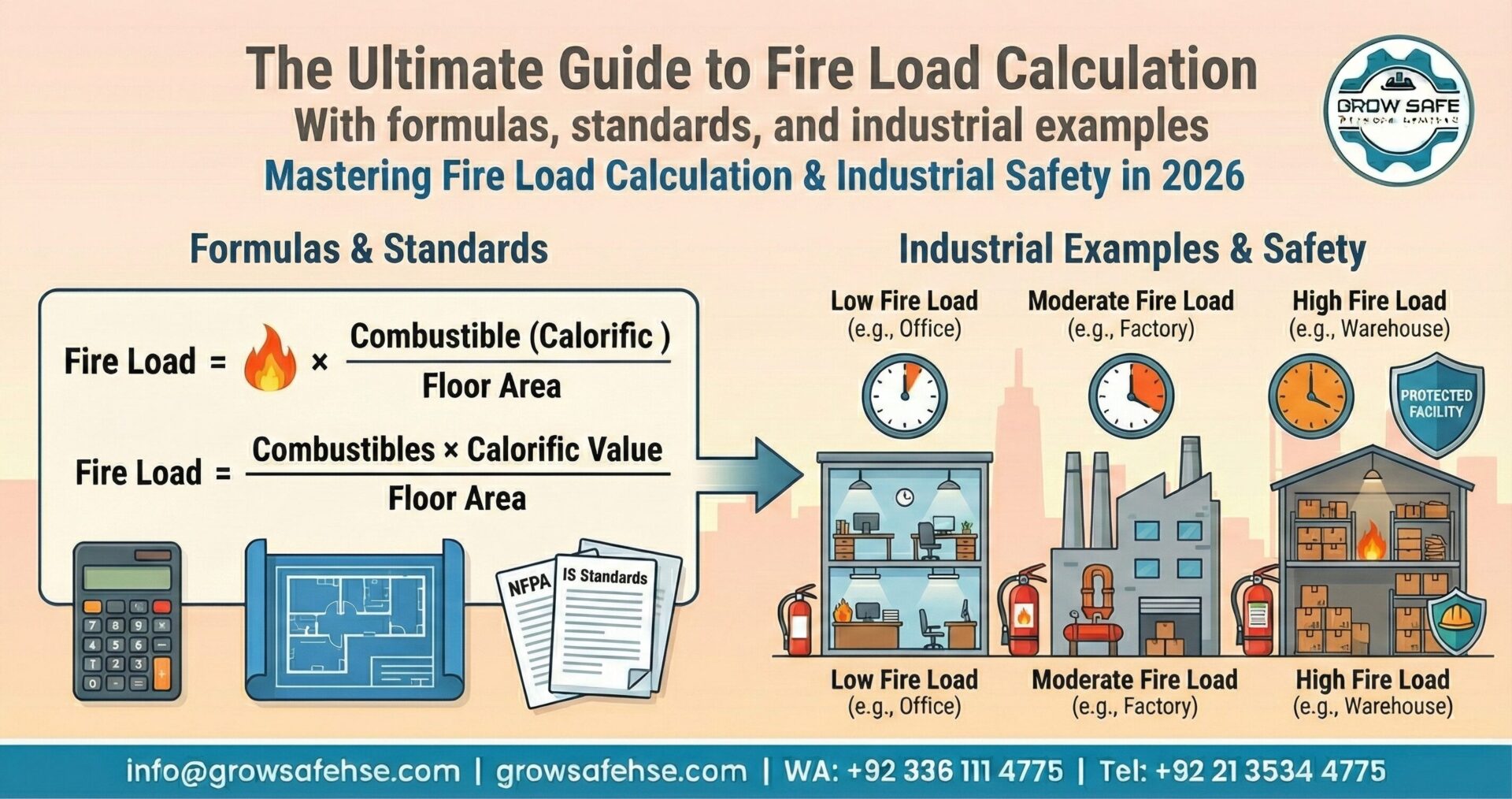
Fire Load = (Combustibles in kg × Calorific Value in kcal/kg) ÷ Floor Area in square meters
Key Components
- Combustibles (kg): Total weight of all flammable materials, including furniture, inventory, packaging, and structural wood.
- Calorific value: Amount of heat released during complete combustion of a unit mass of material.
- Net vs. gross calorific value: Net calorific value is typically used in safety assessments because it represents the realistic heat available during a fire.
Classification of Occupancies by Fire Load
Based on the Fire Offices Committee (UK) and relevant IS specifications, occupancies are classified into three main categories.
1. Low Fire Load
- Examples: Residential buildings, hotels, offices, schools
- Threshold: Not exceeding 275,000 kcal per sq. meter
- Fire resistance: About 1 hour is generally sufficient
2. Moderate Fire Load
- Examples: Retail shops, bazaars, standard factories
- Threshold: Between 275,000 and 550,000 kcal per sq. meter
- Fire resistance: Typically requires 2 hours
3. High Fire Load
- Examples: Godowns, warehouses, chemical storage facilities
- Threshold: Exceeding 550,000 kcal per sq. meter
- Fire resistance: Minimum 4 hours required
Actual Case Study: Calculating Industrial Fire Load
Below is an example from a manufacturing facility using multiple combustible materials.
| Material | Quantity (kg) | Floor Area (m²) | Calorific Value (kJ/kg) | Calculated Fire Load (kcal/m²) |
|---|---|---|---|---|
| Paper | 1,000 | 10 | 15,600 | 373,205.74 |
| Wood | 20,000 | 20 | 17,500 | 418,602 |
| Coal | 100,000 | 50 | 20,000 | 9,569,377.99 |
| Rubber | 5,000 | 25 | 40,000 | 1,913,874 |
| Petroleum | 50,000 | 30 | 43,000 | 17,145,135.57 |
Total Fire Load: 29,420,195.3 kcal/sq. meter
Conclusion: This occupancy falls under the high fire load category and requires minimum 4-hour structural fire resistance.
Determining Fire Extinguisher Requirements (IS 2190)
Calculating fire load is the first step. The next is ensuring adequate fire protection.
Scenario A: Light Hazard (Engineering Workshop)
- Area: 35,280 sq. meters
- Standard: One 9-liter water extinguisher per 600 sq. meters
- Calculation: 35,280 ÷ 600 = 58.8
- Requirement: Provide 59 extinguishers within a 25-meter radius
Scenario B: High Hazard (Petroleum Processing Unit)
- Area: 45,000 sq. meters
- Standard: Two 9-liter foam extinguishers (or 5 kg dry powder) per 600 sq. meters
- Calculation: 45,000 ÷ 600 = 75
- Requirement: Provide 75 extinguishers within a 15-meter radius
Frequently Asked Questions (FAQs)
Q: What is fire load density?
A: Fire load density is the total heat energy divided by floor area, typically expressed in MJ/m² or kcal/m².
Q: How does NFPA 221 relate to fire walls?
A: NFPA 221 provides standards for high-challenge fire walls designed to remain standing even if the structure on one side collapses due to severe fire exposure.
Q: What is fire grading for a 2-hour resistance?
A: Under standard fire resistance grading systems, a 2-hour resistance generally corresponds to Grade 3.
Why a Professional Fire Safety Audit Matters
Fire load calculation is a technical task that requires precision. For industries in Pakistan, staying compliant with civil defence and building codes is critical. Grow Safe provides expert fire safety audits, gap analysis, and technical testing to ensure your calculations are accurate and your facility is properly protected.
Request a Professional Fire Safety Audit
Get in touch today
👉 https://growsafehse.com/contact-us/